
Shopping Online Addiction: Beat One-Tap Checkout
Shopping online addiction is a buying loop that e-commerce design keeps feeding: one-tap checkout, saved cards, flash-sale timers and retargeting ads strip out every pause between wanting something and paying for it. A budget review after the fact rarely changes the next order. What works is putting a pause back in the seconds before you pay, one trigger at a time.
Disclosure: Luuna is our app. We say plainly what it does today, what it doesn't, and what's on our roadmap.
Is online shopping an addiction, or just a habit?
For most people reading this, it's a habit: one-tap orders on autopilot, with no spreadsheet and no plan. Whether it has tipped into something clinical depends on a few specific markers rather than on how much you buy.
What researchers actually call it
Clinicians call the severe version compulsive buying disorder, or oniomania. It shows up as a preoccupation with buying, buying to change your mood, and purchases that cause distress or harm. Psychiatrist Donald Black's clinical review describes it as excessive, poorly controlled buying that leads to distress or impairment (Black, World Psychiatry, 2007).
By that definition, most one-tap ordering doesn't qualify. It's a habit that a checkout built to remove every pause is very good at exploiting.
Signs your habit has crossed the line
The line sits at control and consequence. Ordering DoorDash on autopilot is a habit. Feeling unable to stop, hiding packages, or carrying balances you can't clear is a problem worth talking to a professional about.
If your “where did my money go” moments come every week and the answer is always the same few apps, that's the signal to build friction before checkout. Luuna was built for exactly that moment.
Why does one-tap checkout make shopping online addiction worse?
Every mechanic in a modern checkout is engineered to remove the pause between wanting something and paying for it, and that pause is where a budget lives. One-tap order buttons shrink the decision window to a couple of seconds, which is why an Amazon or DoorDash order can go through before you consciously register it.
Saved cards and stored addresses take away the physical act of reaching for a wallet, so your hands never get the chance to slow your brain down. Flash sales and countdown timers add a fake deadline, turning “do I want this?” into “can I get it before the clock runs out?” Retargeting then re-serves the item you almost bought until you give in.
One-click checkout removes the pause
The decision and the payment collapse into a single tap, leaving no gap in which to say no.
Saved cards and stored addresses
With your card and address already on file, paying takes zero physical effort.
Flash sales and countdown timers
A ticking clock replaces “should I?” with “can I beat the timer?”
Retargeting keeps the item in front of you
The cart you left behind follows you across apps and sites until you finish the purchase.
What are the causes of online shopping addiction?
Boredom and the scroll-to-cart loop
The loop usually starts with an empty ten minutes rather than a need. Autoplay feeds and “customers also bought” rows are built to fill that gap, and one-tap ordering turns a passing want into a placed order before the boredom wears off. The scroll is the trigger, and the cart is simply where it lands.
Dopamine peaks at the tap
Much of the hit comes from anticipating the reward rather than receiving it. Studies of the brain's reward system find dopamine responds strongly to the expectation of a reward, which helps explain why the tap feels good and the parcel often doesn't. Delivery is a letdown the design never mentions.
Why budgets fail after the fact
Charts that show where your money went arrive once the decision is over, so they change nothing about the next one-tap order. Friction has to sit in the seconds before you pay, which is the premise behind Luuna. Our privacy policy spells out what the app reads to do that job.
What are the effects of online shopping addiction?
Where the money actually goes
Most of the damage comes from dozens of small one-tap orders: a $14 Uber Eats dinner here, a $23 Amazon add-on there, a $9 Walmart fill-in on the way home. Each one clears your card in seconds, so none of them feels like a decision.
Stacked over a month, that pattern is often the difference between ending the week on plan and not knowing where your money went until you check your balance.
The return-and-regret cycle
The second cost is time and attention. The package arrives, the mood that drove the order is gone, and now you're opening boxes you don't remember wanting. Some orders get returned, and most just sit there.
Luuna exists to interrupt this before you pay, and its terms cover what the app does and doesn't promise. The honest limit: it sees the orders you place in its Smart Shopping Mode. A purchase made somewhere else only counts if you've connected a bank.
How to stop an online shopping addiction: trigger-by-trigger countermeasures
Boredom scrolling
Open Amazon, browse, tap buy. Willpower loses this one, so put the friction at the scroll instead: get the shopping apps off your home screen and set a rule that anything over a set amount waits until tomorrow. Plenty of impulse orders don't survive the night. Luuna can go a step further and lock a store's own app with Screen Time, so the reflex tap lands on a Luuna screen with a button to continue in Smart Shopping Mode.
Sale timers and flash deals
Countdown timers exist to collapse your decision window. The countermeasure is a number you commit to while you're calm, such as a weekly budget for that store. If the deal is real, it will survive you checking that number first (it usually doesn't).
Saved payment info
One-tap ordering works because your card is already stored. Baymard Institute's checkout research puts cart abandonment near 70%, with complicated checkouts among the leading causes, which is why stores work so hard to remove every step. Add a step back: delete saved cards from your top two stores, or shop those stores in Luuna's Smart Shopping Mode, where your weekly number sits on screen and every checkout gets a check before the order goes through.
Retargeting and push notifications
Turn off marketing notifications for shopping apps and clear cookies after a browse session. Retargeting can't follow what it can't see.
| Trigger | Where it hits | Countermeasure |
|---|---|---|
| Boredom scrolling | Home screen | Hide or lock the apps, 24-hour rule |
| Sale timers | Product page | Weekly budget set in advance |
| Saved cards | One-tap checkout | Delete stored cards, add a pause |
| Retargeting | Push notifications and ads | Notifications off, clear cookies |
For the stores it supports, Luuna handles the app lock and keeps your weekly number in front of you at checkout. The rest are settings changes you can make today in a few minutes.
Do blockers work, or do you just uninstall them?
Blunt blockers vs checkout friction
Most blockers fail because they treat every purchase as the problem. When an app says no to your weekly grocery run the same way it says no to a 2am impulse buy, you uninstall it. The friction that sticks is tied to a number you chose: you see what each order does to your week before you pay, and the hard stop only arrives once that week's budget is spent.
What Luuna does at the moment before you pay
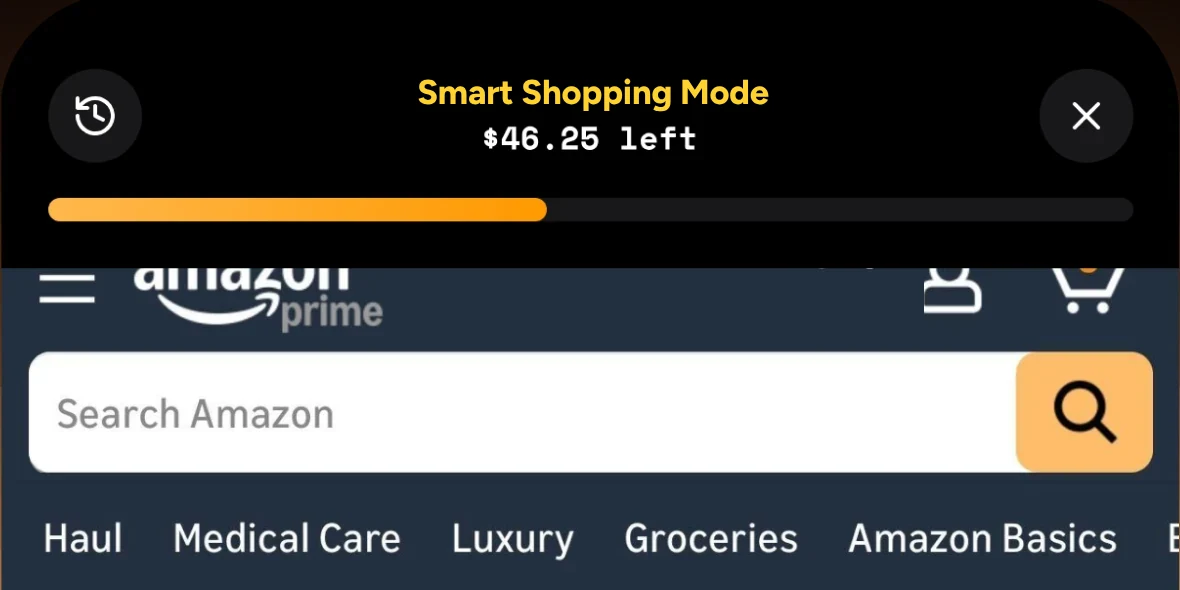
Luuna is built around that moment. You give each store you shop a weekly budget, then shop Amazon, Walmart, Target, Uber Eats and DoorDash inside its Smart Shopping Mode, with what's left of your week pinned above the page. If you want a second read on what's in front of you, tap Luuna Guide for Luuna's take on the page.
At checkout, Luuna steps in with a “Hold on…” screen that shows where the order leaves your week. You can tap “I'll think about it” or continue, so that call stays yours. Once a store's weekly budget is spent, Luuna closes that store in Smart Shopping Mode until the next week starts. What you saved this month shows up on Home, along with your streak of weeks under budget.
On Max, you can add an accountability partner: someone you trust gets a heads-up text when you're close to your budget and can unlock a purchase once a store's week is spent. Luuna doesn't text them until they reply YES, and they can text STOP anytime. That bit of social weight tends to matter more than any setting you can toggle off.
Where Luuna falls short
- iPhone only. There's no Android version.
- Purchases outside Smart Shopping Mode only count if you connect a bank. On the roadmap: Apple Pay taps in stores and order-confirmation emails.
- App locks cover up to three stores on Core. Max covers every store Luuna supports.
- No shared household budget. Each person keeps their own weekly numbers.
Why does after-the-fact tracking lose this fight?
Most budgeting apps work on the same timing. Bank-sync trackers pull in your purchases once the charge clears, and manual-entry apps ask you to log an order after you've placed it. Either way, the number shows up after the decision.
Urgency and scarcity cues are built to work in the seconds before checkout, and a weekly budget chart arrives hours or days later. The only countermeasure that matches the trigger's timing is one that fires in those same few seconds, which is the bet Luuna makes.
What if you've already tried and quit?
Most failed budgets die because they ask for a full audit on day one. Skip that. Pick the one store you regret most and put friction only there.
Start with the store you regret most
Don't categorize a month of past orders. Decide what you're comfortable spending at that single store each week, set it as that store's weekly budget in Luuna, and do your next order through Smart Shopping Mode instead of the one-tap app. After two good weeks, add the next store.
Accountability that survives week three
Week three is a common place for a new habit to slip. Keep the goal small enough to hit, like one store under budget for the week rather than a perfect month, and let your streak count the weeks for you. If you want backup, name an accountability partner who's in the loop when you're close to your number.
A goal you can keep beats a perfect one you quit. If you've bounced off budgeting apps before, that says more about an app asking for too much at once than about your ability to change.
FAQ
I have an online shopping addiction. What's the first thing I should do today?
Pick the one store you regret most, usually Amazon or DoorDash, and decide while you're calm what you're comfortable spending there each week. Then remove the one-tap path: delete the saved card, or lock the store's app and shop it through Luuna's Smart Shopping Mode instead. Skip the full money audit. If buying feels out of your control or is causing real harm, talk to a doctor or therapist too.
How do I stop online shopping addiction when everything is saved on my phone?
Put back the friction your phone removed. Delete stored cards from your top two stores, move shopping apps off the home screen, and turn off marketing notifications so retargeting can't reach you. Luuna can also lock a store's own app with Screen Time and send you to that store in Smart Shopping Mode, where your weekly number sits on screen and every checkout gets a check before you pay.
Is there an online shopping addiction subreddit that actually helps?
r/shoppingaddiction exists, and it shows how common compulsive buying is. A forum can't sit inside your checkout, though. Whatever support you lean on, pair it with friction at the moment of payment and someone you trust who knows when you're close to your number.
Can I stop impulse buying without giving up Amazon Prime or DoorDash?
Yes. You can keep Prime, keep ordering DoorDash and still add friction: a 24-hour rule for anything over a set amount, and a check against your weekly budget before any flash deal. Luuna works the same way, since you keep shopping at the same stores with a weekly number you chose. Friction tied to your own budget holds up far better than blockers that treat every order, groceries included, as a problem.
Why do I keep buying stuff I return a week later?
The reward hit comes from anticipating the purchase more than owning it, so the tap feels good and the parcel often doesn't. By the time delivery arrives, the mood that drove the order is gone. That's the return-and-regret cycle, and the best place to interrupt it is at checkout, while a short pause can still change your mind.
Try Luuna free while it's in beta. Give the stores you shop a weekly budget and see where each order leaves you before you pay.
Get early access